At noon, a California battery operator wants cheap electricity. At seven, the same operator wants expensive electricity. For a while, the sun made that a pretty good business. Solar panels poured power onto the grid in the middle of the day. By the time people got home and turned on the oven, solar output was falling. Anyone who could buy power at lunch and sell it at dinner had a customer.[1]
Now imagine every battery owner showing up for the same dinner rush. That’s the part of California’s storage boom I’d want to understand before financing another project.
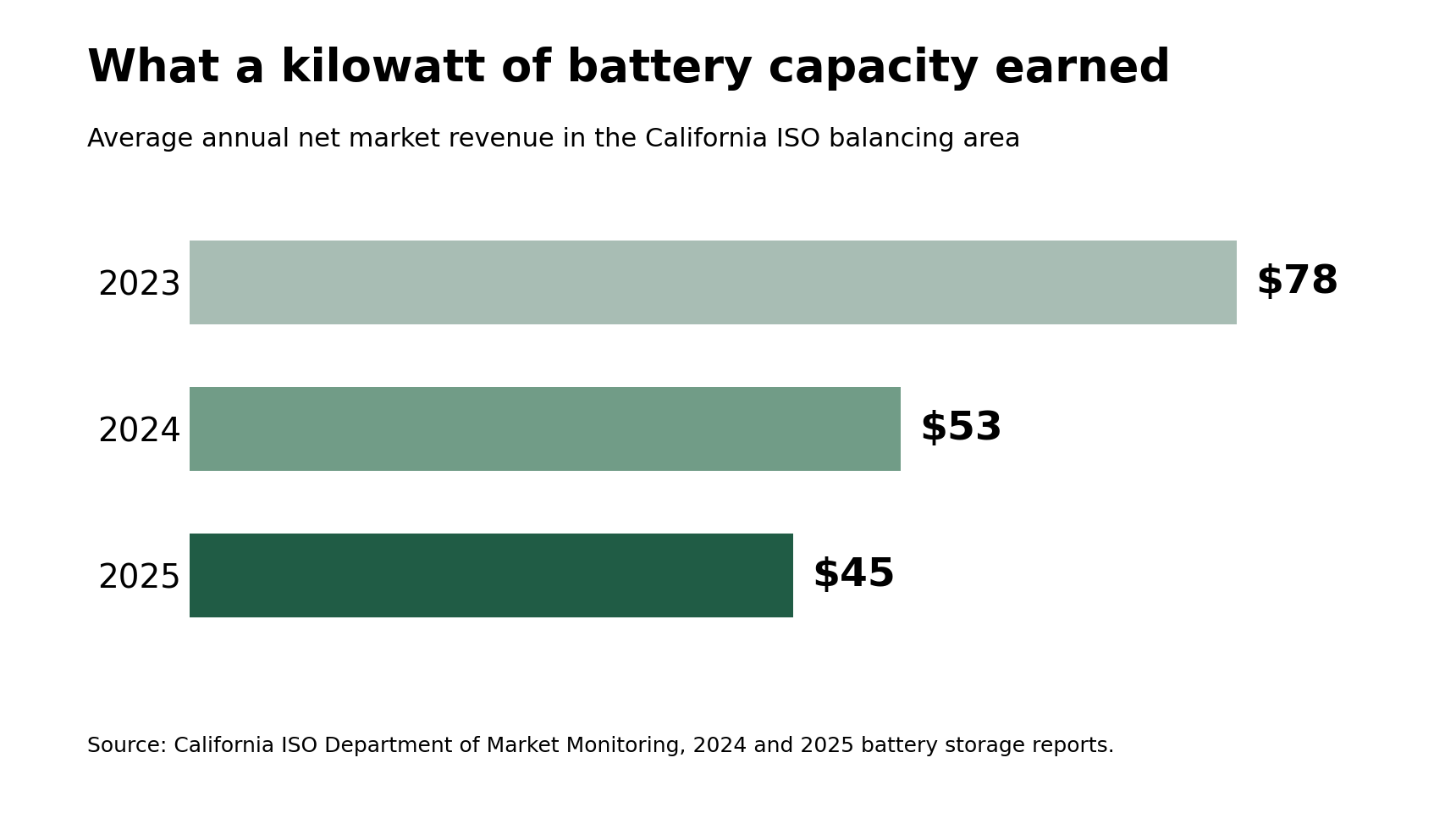
The batteries themselves are doing their job. On the grid run by the California Independent System Operator, batteries discharged three times as much electricity in the first five months of 2026 as they did in the same months of 2024. But look at the business from the owner’s side. In 2023, a kilowatt of battery capacity earned about $78 in net market revenue on average. In 2024, it earned $53. In 2025, it earned $45. That’s a roughly 42% drop in two years.[2][3][4]
Everybody wants to sell at seven
Think about what happens when one more battery joins the grid. It buys at noon, adding a little demand when electricity is cheap. It sells in the evening, adding a little supply when electricity is expensive. Do that at enough substations and the two prices can move closer together. The battery fleet is solving the very shortage its owners were counting on to get paid.[1][4]
California’s market monitor attributed most of the 2025 revenue decline to lower peak power prices. Several things can move those prices, so it would be a stretch to blame batteries for the whole decline. But for an owner relying on expensive evenings, the cause matters less than the arithmetic. Take a hypothetical 100-megawatt project. At the 2023 fleet average, it would have earned about $7.8 million in annual net market revenue. At the 2025 average, that falls to $4.5 million. Try explaining the missing $3.3 million to the lender.[3][4]
What I’d ask before writing the check
There’s a good answer a developer could give. A utility can pay a battery owner to have capacity available when the grid gets tight. That payment buys something valuable even in a year with few price spikes, and it sits outside the wholesale revenue figures above. A project with a dependable contract can tell a very different story from one that needs a string of expensive evenings to cover its debt.[4]
So I’d ask to see two numbers side by side. How much annual debt service does the project owe? And how much of it can the project cover with contracted payments after operating costs? Then I’d ask what evening power price the owner needs to close the gap. A forecast that quietly assumes a return to 2023 deserves a harder look.
California has made a persuasive case for putting batteries on the grid. The next developer who comes looking for money should have to make a more specific case. If the battery across the street is ready to sell at seven, too, what makes yours worth financing?
- U.S. Energy Information Administration. Annual Energy Outlook analysis of battery storage and energy arbitrage
- U.S. Energy Information Administration. Solar generation in CAISO surpassed natural gas in the first five months of 2026
- California ISO Department of Market Monitoring. 2024 Special Report on Battery Storage
- California ISO Department of Market Monitoring. 2025 Special Report on Battery Storage
- Cover photograph. Renewableandalternativeenergy, via Wikimedia Commons
- Photo license. CC BY-SA 4.0